Slab Leak Detection Redwood City, CA
A warm patch on the floor. The sound of water in a quiet house. A bill that doubled while nothing changed. When a pressurized line under the concrete starts to fail, Leak Detection Pros provides the slab leak detection Redwood City, CA homeowners need before anyone talks about cutting: we isolate the line, test it and pinpoint the break electronically, so the repair decision rests on evidence, not a guess with a jackhammer.
Signs Your Home Has a Slab Leak
A slab leak usually shows itself through symptoms elsewhere in the house long before water appears. These signs mean a line under your foundation is losing water:
- A warm or hot spot on the floor — the classic signature of a hot-water line leaking under the slab
- The sound of running water when every fixture in the house is off
- A water bill that jumped with no change in use — the most common first clue
- The meter keeps moving even with the house shut off at the fixtures
- Damp carpet, warped laminate or a musty smell in one area that never fully dries
- New cracks in flooring, tile or walls as the soil under the slab washes out
- Low water pressure that affects the whole house rather than a single fixture
Not every Redwood City home sits on a slab — many postwar tracts have raised foundations with crawl spaces, while slab construction clusters in Eichler tracts and newer builds like Redwood Shores. If yours has a crawl space instead, our crawl space leak detection service covers the underfloor equivalent. Either way, step one is identical: confirm it and pinpoint it before anything is opened.

Start With the Meter
Before you call anyone, run this check: turn off all water in the house and look at your meter's low-flow indicator. If it is still turning, water is moving somewhere it should not be — and your hourly usage in the City's My Water portal helps separate an under-slab leak from a running toilet or irrigation problem.
How We Pinpoint a Slab Leak Without Guesswork
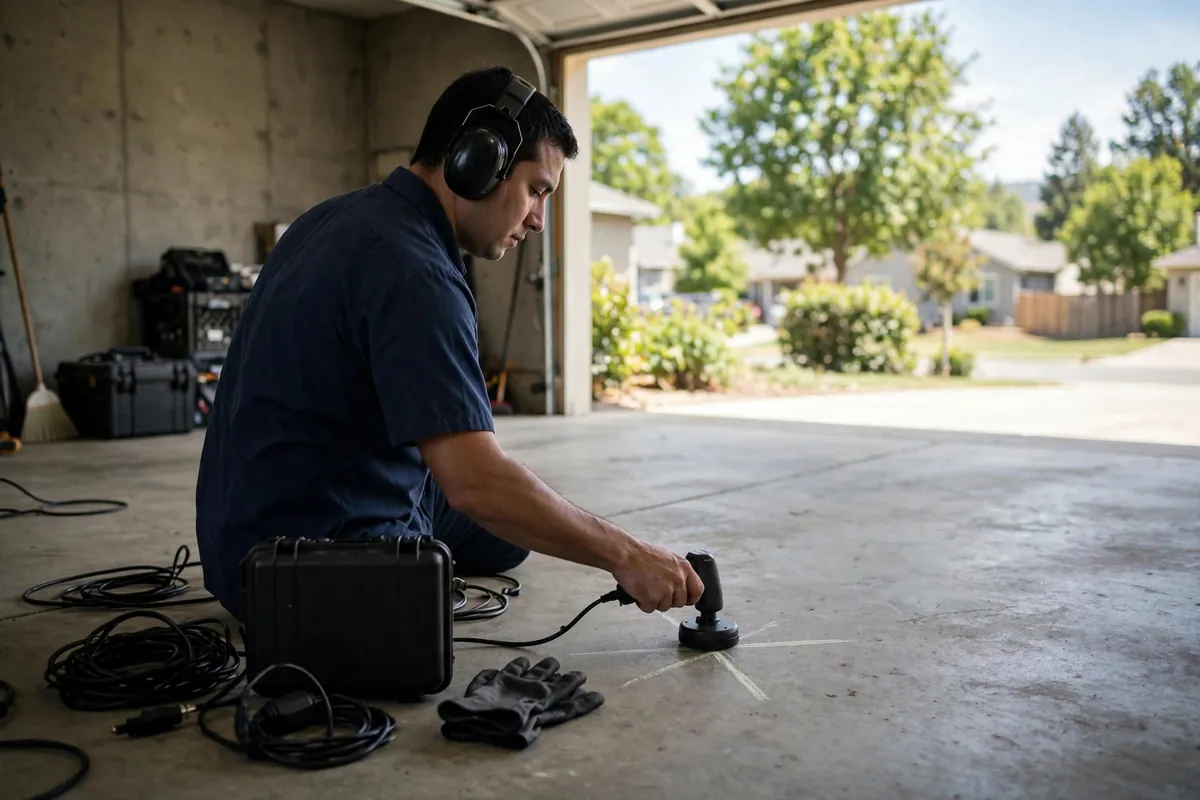
The leak is found with instruments, not demolition — concrete stays untouched until the break is located and marked:
Isolate Hot vs. Cold
We shut down branches one at a time to learn which line is leaking.
Pressure Test
A gauge on the isolated line confirms the leak and measures how fast pressure — and your money — is dropping.
Trace the Pipe Run
Electronic tracing maps where the line actually travels under the slab, which is rarely where the drawings say.
Acoustic Pinpoint
Ground microphones pick up the leak's signature hiss through the concrete; the signal peaks directly over the break.
Thermal Confirm
An infrared camera confirms the spot — a hot-water leak paints a warm plume on the floor.
Mark & Report
The spot is marked, photographed and written up before any repair is quoted.
What Actually Causes Slab Leaks Here — and One Myth Worth Correcting
Slab leaks in Redwood City are overwhelmingly an age-and-environment problem, not a water-quality problem.
You will read on some plumbing sites that "mineral-rich water" eats through under-slab copper — that may hold where supplies are mineral-heavy, but not here. Redwood City's water comes from the Hetch Hetchy system and is some of the softest in California, with hardness around 8 mg/L. Minerals are not what is pinholing pipes under Peninsula floors.
What we actually find, in a city where 61% of homes were built between 1940 and 1980, is a combination of age, pressure and movement. Copper that has carried water for fifty-plus years thins from the inside. Fluctuating street pressure works the line day and night. Bay Area clay soils swell when wet and shrink when dry, shifting the slab and stressing the pipe where it passes through concrete — and a pipe that rubs against concrete or rebar eventually wears through. On the bayside, saturated soft soils let a leak run for a long time without surfacing, which is why the water bill, not a puddle, is usually the first warning. Which of these is at work in your home decides whether one repair ends the story or starts a series of them.
A Warning About Post-Tension Slabs
Many Peninsula slabs are post-tensioned: steel cables inside the concrete are held under enormous tension, and cutting one blind can make it snap with dangerous force. The worry is legitimate — it is a real risk with careless work.
Our process handles it in order: pinpoint first, then scan the area before any concrete is opened, so tension cables and the pipe run are located and marked. Nothing gets cut on a guess — which is also why a reroute, avoiding the slab entirely, is sometimes the safer call, and we will tell you when it is.
Your Three Repair Options — and What Each Typically Costs
Once the leak is marked, there are three honest ways to fix it — and the right one depends on the condition of the line, not on what a company prefers to sell:
| Option | What It Involves | Typical Range |
|---|---|---|
| Slab leak locating (detection) | Isolate, pressure test, acoustic and thermal pinpoint, written report | $500 – $1,200 |
| Spot repair | Open the slab at the marked spot, cut out the failed section, restore the concrete | $1,500 – $3,500 |
| Reroute | Cap the leaking under-slab line and run a new line overhead or around it | $2,000 – $4,500 |
| Epoxy pipe lining | Coat the inside of the existing line where its condition allows | $1,000 – $3,000 |
| Concrete restoration | Patching and finishing the opened area after a spot repair | $500 – $1,500 |
A spot repair makes sense when the rest of the line is sound — one leak, healthy pipe, done. A reroute makes sense when the under-slab run itself is the problem: you stop using it instead of betting it will not fail two feet further along. And when the line has leaked before or is thinning in several places, the honest conversation is about repiping — paying for detection and concrete work a second and third time is how a modest problem quietly becomes a five-figure one. We lay out the evidence and the 5-to-10-year math for each option, then you choose.
The pattern is the same in Redwood Shores' newer slab homes as in the older tracts — find it first, then fix it once.
Why Homeowners Here Choose Us for Slab Work
Slab work is where the expensive mistakes happen, so the standard matters more than the pitch. Three things define how we handle these calls:
- Evidence before demolition. You see the acoustic readings, the thermal image and the marked spot before anyone proposes opening your floor.
- An insurance-ready written report. It records the source, the readings and the resulting damage — the details insurers ask for when tear-out and water damage are part of a claim. It is the same report-first standard described on our home page.
- Local since 2018. We work this housing stock every week — postwar tracts, Eichlers, bayside slab homes — and detection and repair are priced separately, so you are never locked into a repair you have not chosen.
Related Services
Slab Leak Questions Homeowners Ask Us
What are the signs of a slab leak?
The classic signs are a warm or hot spot on the floor, the sound of running water when every fixture is off, a water bill that jumps without explanation, damp carpet or warped flooring, and cracks appearing in walls or floors. Any one of these on its own is worth a meter test; two together usually mean a pressurized line under the slab is leaking.
Can you find a slab leak without breaking up my floor?
Yes — finding it is the non-destructive part. We isolate the hot and cold lines, pressure test them, trace the pipe run and listen with acoustic equipment until the signal peaks over the break, then confirm with thermal imaging. The spot gets marked on the floor. Concrete only gets opened afterward, in one targeted place, if you approve a spot repair.
How much does it cost to find and fix a slab leak?
Locating a slab leak typically runs $500–$1,200 depending on the size of the home and access. If you repair it, a spot repair through the slab usually runs $1,500–$3,500, a reroute $2,000–$4,500, and restoring the opened concrete $500–$1,500. Detection is quoted separately from repair, and you see the range for your chosen option before work starts.
Spot repair, reroute, or repipe — how do I decide?
It depends on the condition of the line, not just the leak. A single leak in an otherwise sound line is a spot repair. A line that has leaked before, or copper that is thinning in several places, is usually better bypassed with a reroute. And when leaks keep appearing in different places, repiping ends the cycle instead of paying for detection and concrete work again and again. We show you the pipe condition evidence and the math for each option.
Will homeowners insurance cover a slab leak?
In the standard pattern, insurers often cover the resulting water damage and the cost of tearing out and restoring access to the pipe, while the repair of the failed pipe itself is usually on the homeowner — and slow, gradual leaks are commonly denied as wear and tear. Every policy differs, so documentation matters. Our written detection report records the source, the readings and the damage in the format adjusters ask for.
Is it dangerous to cut into a post-tension slab?
It can be, which is why nobody should jackhammer a Peninsula slab blind. Many slabs here are post-tensioned with steel cables under high tension, and cutting one can cause it to snap violently. Before any concrete is opened, the area is scanned so cables and lines are located and marked — one more reason the pinpoint and the scan always come before the repair.
How long does it take to pinpoint a slab leak?
Most slab leaks are pinpointed in a single visit, usually within a few hours. The sequence is: isolate the line, pressure-test it to confirm the leak is real, trace the pipe run, then narrow the spot with acoustic listening until the leak is marked on the floor. Repairs such as a spot fix or a reroute are scheduled after that, once you have chosen the option — detection and repair are separate decisions with separate prices.
If the water here is so soft, what actually causes slab leaks?
Age and contact, mostly — not hard water. Redwood City water comes from the Hetch Hetchy system and is very soft, around 8 mg/L of hardness, so the mineral-buildup story you may see online does not apply here. Under-slab copper usually fails after decades of soil contact, pressure stress and simple age, and about 61% of Redwood City homes were built between 1940 and 1980, which puts a lot of original piping at or past its service life. Soil that swells when wet and shrinks when dry adds seasonal movement on top of that.
Suspect a Slab Leak? Get It Marked Before It Spreads.
An under-slab leak washes out soil, feeds mold and inflates every bill while it runs. One visit marks the exact spot and gives you the repair options with real ranges.
Call (650) 632-9185 Request a Quote