Leak Detection Friendly Acres
Most leak detection Friendly Acres calls start with a number that does not add up — a water bill that jumped while nothing in the house seems wet, broken or even damp. These postwar homes, built in the wave that put 61% of Redwood City's housing up between 1940 and 1980, hide their leaks well: silent toilets, yard lines under the lawn, supply pipes aging behind walls. Leak Detection Pros works through them in order — meter first, then isolation, then acoustic and thermal pinpointing — so you get a marked location and a written report, not a guess.
Postwar Homes, Plumbing to Match
Friendly Acres grew up in the postwar building wave — practical family homes around Fair Oaks Avenue, all plumbed in the same era and aging together.
Neighborhoods built in a single era age as a group. The supply lines in these homes went in within the same couple of decades, from the same generation of materials — galvanized steel and copper supply pipe, cast-iron and clay drainage — and they are reaching the end of their service lives on the same schedule. The odds have shifted: corrosion that took fifty years to matter is now a when, not an if, and the failures tend to start small — a flapper that no longer seals, a threaded joint weeping inside a wall, a yard line pinholing under the lawn.
It also means the detection visit here follows a familiar script. Start with the fixtures that waste water silently, especially toilets. Check the meter and the hourly usage pattern in the city's My Water portal. Isolate the house from the yard line to learn which side is losing water. Then go find it with the listening gear. Most Friendly Acres mysteries are solved in that order, and the answer is documented in a written report you can keep — or hand to your insurer if damage was done.
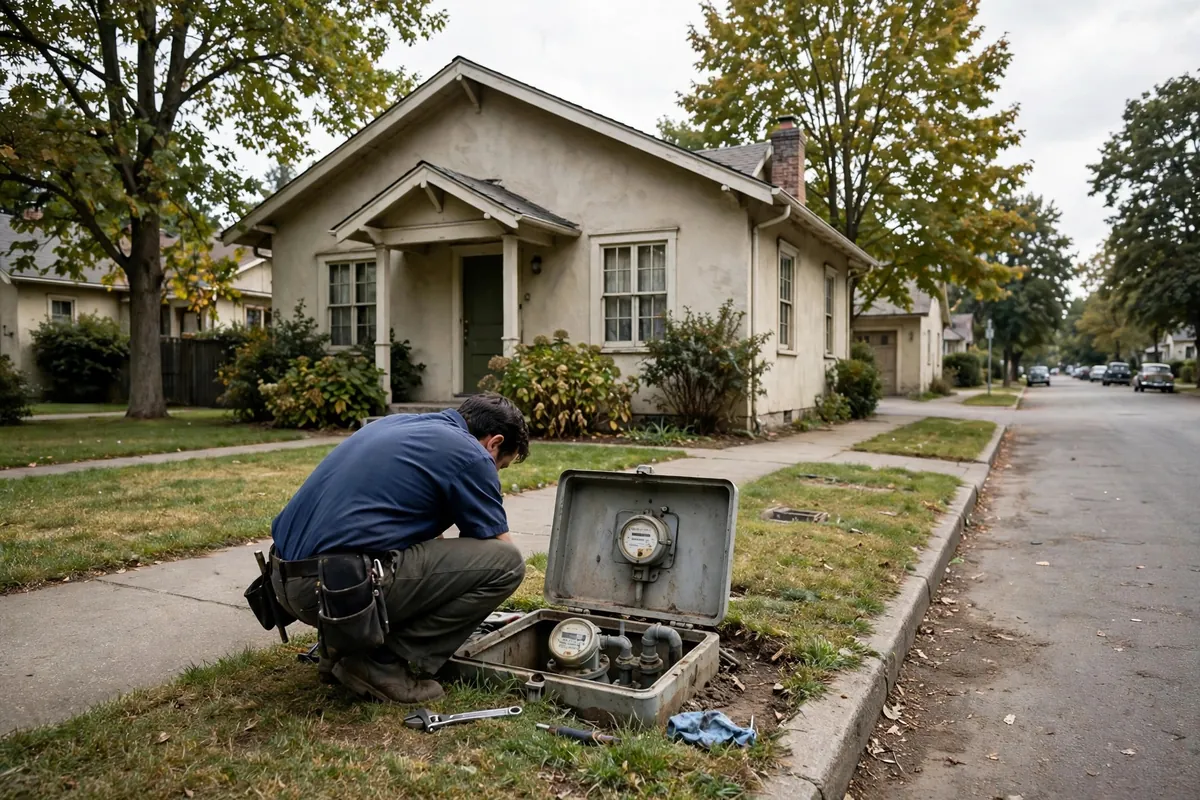
Start With the Meter, Not the Walls
The single most useful leak test costs nothing: everything off, eyes on the meter's low-flow indicator. If it moves, water is escaping. That ten-second check tells us whether to hunt inside the house, in the yard line, or at the fixtures — before any tool comes out.
Leak Problems We See Most in Friendly Acres
The neighborhood pattern is quiet waste: leaks that run around the clock and bill you for water nobody used.
- Silent toilet leaks — worn flappers passing hundreds of gallons a day straight into the bowl, no sound, no puddle
- Yard service line leaks — the meter-to-house run losing water underground, visible only on the bill
- Aging supply lines in walls — pinholes at threads and elbows that stain paint long after they start
- Slow drains from aging laterals — cast-iron and clay lines scaling, cracking and catching roots at the joints
- Irrigation leaks — cracked lines and stuck valves watering the soil instead of the yard
- Water heater valve drips — relief valves and fittings weeping into pans and garage floors
A local story worth knowing: a Redwood City resident's usage alert in the My Water portal caught a broken irrigation line early — after a hose left running for days had already added about $200 to a bill. Postwar neighborhoods run a lot of irrigation. Set the alert; it watches when you cannot.
There is a second layer of watching available to this neighborhood, and it comes from the city itself. Redwood City has partnered with Flume on a discounted smart water monitor for residents — a device that straps onto the meter and tracks flow in near real time, flagging usage that never stops. Between the My Water portal's hourly history and an alert that fires when water runs when it should not, a Friendly Acres homeowner can often see a leak's signature the week it starts instead of the month the bill arrives. Neither tool pinpoints a pipe — that still takes a visit — but they turn detection from a quarterly surprise into a same-week phone call.

Services We Run in Friendly Acres
The three services behind most calls from this neighborhood:
Water Leak Detection
The full hunt for hidden leaks — walls, yard lines and under floors — starting from the meter and narrowing down.
Learn more →Toilet Leak Repair
Silent flappers and running toilets tested and fixed — often the cheapest water bill you will ever lower.
Learn more →Drain Cleaning
Slow and stubborn drains in aging lines, cleared properly — with a camera check when a blockage keeps returning.
Learn more →Friendly Acres ZIP Code: 94063
Friendly Acres addresses sit in ZIP code 94063, east of downtown along the Fair Oaks Avenue corridor — the same ZIP as our Convention Way office.
Our Redwood City leak detection homepage covers the detection process step by step if you want the full picture first. Nearby areas on the same routes:
Reading Your Hourly Usage Like a Technician
Redwood City's My Water portal shows your home's water use hour by hour. Plumbers read that graph the way mechanics listen to an engine — here is what we look for.
Start with the overnight hours. A healthy house at 3 a.m. uses no water at all — the graph should sit on zero for hours at a stretch. If it never reaches zero, something in the system loses water continuously. That single observation cuts the suspect list in half before we arrive: continuous loss means a supply line, a yard line, or a fixture that passes water day and night. Loss that appears only in blocks, at particular hours, means something on a schedule — and in this neighborhood, that usually means irrigation.
A toilet leak has its own handwriting. A tank with a tired flapper refills in small sips, so the graph shows a repeating sawtooth of little draws, all day and all night, whether anyone is home or not. An irrigation break looks different: big draws at the controller's hours, sometimes longer or larger than the same zone used to take, with clean zeros in between. A yard-line leak is the steadiest of the three — a flat line of loss that ignores the clock entirely, because the pipe does not know what time it is.
None of this replaces the visit. The graph cannot tell a yard-line leak from a toilet two rooms apart, and it was never meant to. What it does is aim the visit. When we arrive we already know whether we are isolating the house from the yard line first, dye-testing toilets first, or walking irrigation zones first — and the pinpoint that follows is faster and cheaper for it.
Try it before you call: open the portal, find a night when nobody was home, and check whether the line touches zero. If it does not, note roughly how much runs per hour. That number is the first thing we will ask about, and having it turns your first phone call from a worry into a diagnosis already in progress.
Friendly Acres Leak Questions
My water bill spiked but I cannot see a leak anywhere. Where is the water going?
Usually one of three places: a toilet leaking silently into its own bowl, the underground line between the meter and the house, or a supply line dripping where you cannot see it. All three waste water around the clock without leaving a puddle. The meter test comes first — if the low-flow indicator moves with everything off, the water is escaping somewhere, and our job is to find exactly where.
How do I check whether my toilet is leaking silently?
A toilet can leak hundreds of gallons a day without making a sound. The simple test: put a few drops of food coloring in the tank, wait twenty minutes without flushing, and check the bowl. If color shows up in the bowl, the flapper is passing water. It is the cheapest check in the house, and in postwar homes with original-era fixtures it finds the culprit surprisingly often.
How can I test the meter myself before calling anyone?
Turn off every faucet, toilet and water-using appliance, then watch the meter's low-flow indicator — if it still moves, water is leaving the system somewhere. For a second data point, Redwood City's My Water portal shows hourly usage: water running at 3 a.m. means a continuous leak like a supply line or toilet, while spikes only at certain hours point toward irrigation.
What does it cost to find a leak in a Friendly Acres home?
A basic leak inspection typically runs $100–$300, electronic acoustic detection $300–$800, and slab or underground locating $500–$1,200, depending on how hidden the leak is. You hear the range before we start, and detection is always quoted separately from the repair, so you decide about the fix with the location already proven.
Once you find the leak, do you repair it too?
Yes. After the pinpoint we walk you through the repair options for that specific leak — a fixture rebuild, a section replacement, or a larger repair if the line has failed in several places — with price ranges for each. Detection and repair stay as two separate quotes, so there is no pressure to decide everything at once.
Can a toilet leak really cost that much on a bill?
Yes. A flapper that no longer seals can pass hundreds of gallons a day, and it does it silently, around the clock. Across a single billing cycle that is thousands of gallons nobody used — easily the size of the spike that sends most homeowners looking for a leak in the walls. The dye test takes twenty minutes and a few drops of food coloring, and in postwar homes it finds the culprit often enough that we run it early in every visit.
What is the Flume monitor, and does it find leaks?
Flume is a smart water monitor that straps onto your meter and tracks flow as it happens. The City of Redwood City partners with Flume on a discounted program for residents, and the monitor alerts you when water runs continuously — the signature of a leak. It tells you that water is escaping and roughly how fast; it does not tell you which pipe. When an alert points to a real loss and the source is not a fixture you can see, that is when a detection visit takes over.
My bill is only high in summer. Can that still be a leak?
Yes — it usually means the leak lives in the irrigation. A cracked sprinkler line or a valve that passes water only loses it when the system runs, so the waste follows your watering schedule and disappears in winter. The My Water portal separates the suspects: usage that returns to zero overnight on non-watering days points at irrigation, while a floor of usage that never reaches zero points at a supply line or toilet. Zone-by-zone isolation on our visit confirms which one it is.
The Bill Is the First Symptom. Let Us Find the Cause.
A quiet leak in a postwar home can run for months before it shows. One visit works it out — toilet, yard line or supply pipe — and hands you the answer in writing, with repair ranges attached.
Call (650) 632-9185 Request a Quote