Leak Detection Farm Hill
Most leak detection Farm Hill calls involve the neighborhood's midcentury ranch homes — single-level, split-level and two-story ranch plans built mostly in the 1950s on the hill above the city. These are raised-foundation homes with crawl spaces, plumbed in an era of galvanized steel, and their original lines are now well past the age where leaks become a pattern instead of an accident. Leak Detection Pros finds them from below and from the meter — pressure testing, acoustic pinpointing and thermal confirmation — with the repair options priced in ranges before any work starts.
Midcentury Ranches on the Hill
Farm Hill was built out mainly in the 1950s — classic midcentury ranch-style and split-level homes, many still wearing their original 1950s designs, and their original plumbing along with them.
The neighborhood climbs the hill west of the city center, and the houses follow the classic Peninsula pattern of their decade: perimeter foundations, a crawl space underneath, and supply and drain lines running below the floor. It is a kind foundation for leak work — most lines can be reached, tested and even seen from below — but it also means a leak can drip into that crawl space for a long time before anyone upstairs notices. The symptoms that finally surface are secondhand: a musty smell that will not clear, a floorboard that feels soft, a bill that rises a little every quarter.
There is a piece of local color worth knowing on this hill: the water tanks above Farm Hill are filled from the Hetch Hetchy system, the same famously soft water that serves the whole city. So when a Farm Hill pipe starts pinholing, the water itself is rarely the culprit. The honest causes are the ones we find under these homes every week — seventy years of galvanized pipe doing its slow arithmetic, joints where remodels met originals, and pressure working on all of it. Diagnosis matters here, because fixing the wrong cause just books the next leak.
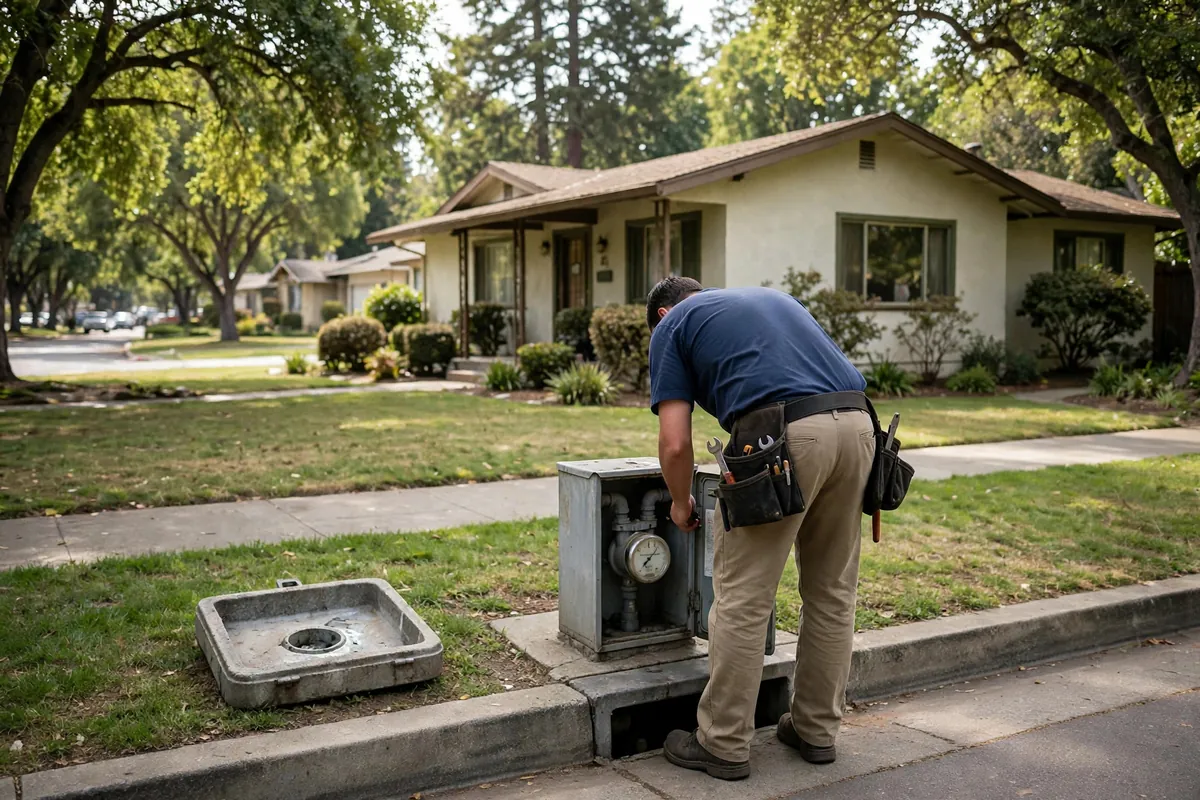
Two ZIPs, One Neighborhood
Farm Hill Boulevard addresses are 94061; the upper streets — Lakemead Way, Highland Avenue — are 94062. Homeowners ask us which one counts. Both do. The ZIP line runs through the neighborhood, not around it, and our coverage follows the neighborhood.
Leak Problems We See Most in Farm Hill
Era leaks in crawl spaces, plus the hillside habit of water showing up somewhere other than where it escaped.
- Galvanized pinholes — internal corrosion opening at threads and elbows, often several in the same season
- Underfloor drain drips — quiet leaks wetting crawl-space soil and the underside of the subfloor
- Old-meets-new joint failures — partial repipes and additions tied into original lines, leaking at the seam
- Uphill leaks surfacing downhill — water following the slope and the pipe trench before it shows
- Root pressure on laterals — mature hill trees working into aging drain joints
- Whole-house pressure drop — scaled original pipe announcing end of life before it leaks outright
Because so many Farm Hill homes share a build decade, we test the system, not just the symptom. The written report you get covers the leaking branch and the condition of the rest — the information that actually decides repair versus repipe.
The ranch plans themselves add a wrinkle worth naming. In a split-level, plumbing stacks across levels: a bathroom on the upper floor drains and feeds through walls and ceilings that belong to the lower one. A leak that starts at an upstairs fitting can ride the framing down and stain a ceiling two rooms away and a half-story below, and the homeowner reasonably concludes the problem is under the lower room. Tracing, not the stain, decides where we open — and in these homes the answer is uphill of the evidence more often than not.
Elevation also means no two Farm Hill homes live with quite the same water pressure. Higher streets see less of it; lower streets, more — and pressure is a slow multiplier on every tired joint in the house. When we test a Farm Hill branch, we note the pressure it is actually living under, because a borderline pipe at gentle pressure and the same pipe at high pressure are two different timelines, and the report should say which one you have.
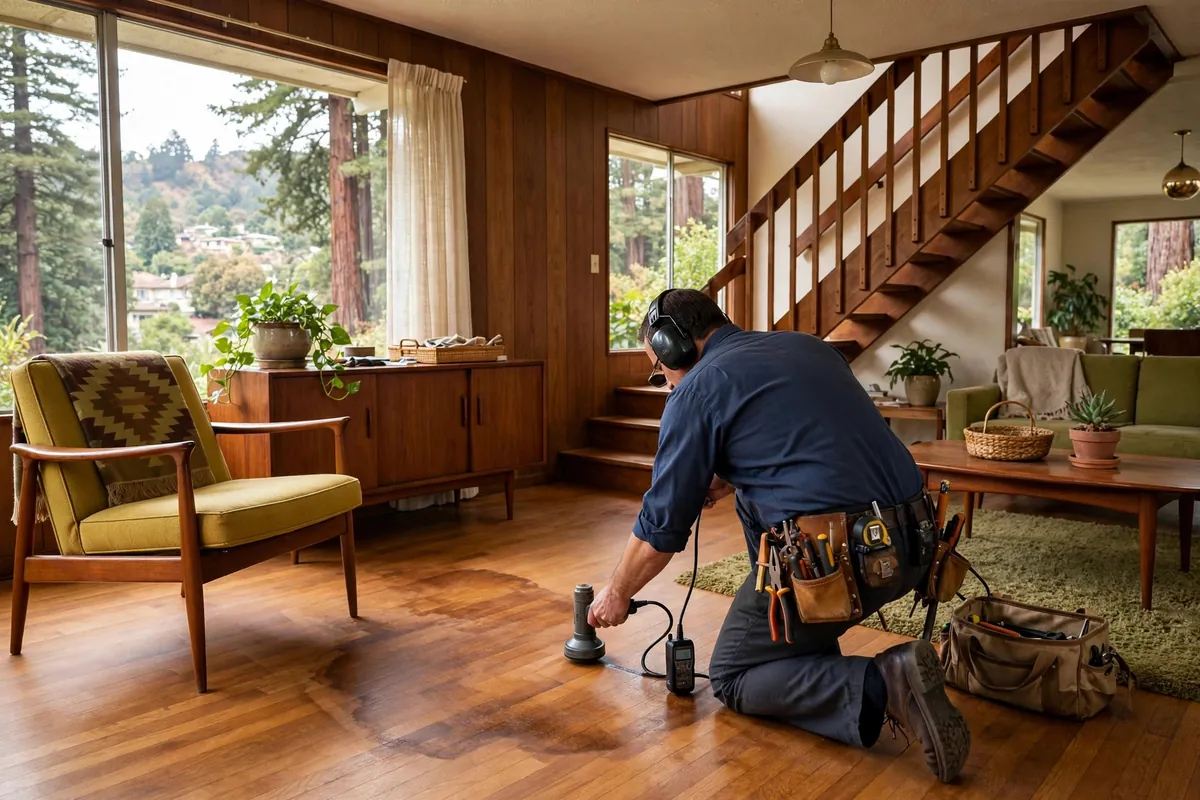
Services We Run in Farm Hill
Every one of these follows the process laid out on our Redwood City leak detection homepage — isolate, test, pinpoint, report:
Crawl Space Leak Detection
The Farm Hill specialty — underfloor leaks in raised-foundation ranch homes, confirmed from below.
Learn more →Repiping
When original galvanized lines fail in several places at once, replacement beats serial repairs — PEX and copper, priced in ranges.
Learn more →Water Leak Detection
Wall, ceiling and yard-line leaks traced with acoustic and thermal equipment, uphill or down.
Learn more →One Neighborhood, Two ZIP Codes: 94061 + 94062
Farm Hill straddles the ZIP boundary — 94061 along Farm Hill Boulevard, 94062 on the upper streets toward Emerald Hills. Both are fully covered, every day.
Adjacent areas on the same hill routes:
Soft Water, Pinholing Pipes: What Is Actually Going On
Farm Hill homeowners ask us this more than anything: if Redwood City's water is famously soft, why are the pipes still failing?
The water really is soft — some of the softest in California. The hill tanks above this neighborhood are filled from the Hetch Hetchy system, the same source that serves the whole city, and published SFPUC water-quality data puts that water's hardness at about 8 milligrams per liter. For scale, water is only called hard at many times that figure. So when sales material for slab work blames mineral-rich water for eating Redwood City pipes, it is describing a city that does not exist. Your pipes are not being dissolved by hard water, because there is barely anything in the water to dissolve them.
What actually fails is older and simpler. Galvanized steel corrodes from the inside as a condition of its own material — decades of contact between steel and any water, soft or hard, rusts the bore until the wall thins at threads and elbows. Copper lines of the same era develop pinholes at their weakest points, helped along by pressure and by contact with soil where lines run underground. Neither process needs help from minerals. Both are, at heart, arithmetic: the pipe was installed in the 1950s, its expected life was forty to fifty years, and the calendar has done the rest.
Why does the distinction matter to you? Because a diagnosis built on the wrong cause sells the wrong cure. If hard water were the culprit, treatment gadgets would be the answer and the pipe could stay. When the cause is age, the honest menu is the one we price: repair the failed section, reroute around it, or replace the system — chosen by test results, not by a story about your water. A detection visit that cannot explain your leak without blaming the city's famously soft supply is a visit that has not found your leak yet.
So we test. Branch by branch, the gauges separate the pipe that is genuinely at end of life from the pipe that has decades left, whatever any brochure says about either. That is the Farm Hill answer to the soft-water question: the water is innocent, the calendar is not, and the difference between the two is measurable in your crawl space.
Farm Hill Leak Questions
Which ZIP code is Farm Hill — 94061 or 94062?
Both, honestly. Farm Hill straddles the line: addresses along Farm Hill Boulevard itself sit in 94061, while upper streets such as Lakemead Way and Highland Avenue fall in 94062. It makes no difference to your service — we cover both ZIP codes, and the same crew, equipment and pricing ranges apply on either side of the line.
My Farm Hill home is a 1950s ranch. Where do leaks usually start?
In the original-era plumbing these homes were built with. Galvanized supply lines of that period are now decades past their expected life, so pinholes at threads and elbows are common, and underfloor drain lines drip quietly into the crawl space. The other frequent starting point is where a later remodel or partial repipe ties into the original pipe — that joint tends to fail first.
How do I know if the leak is under my floor?
Run the meter test: everything off, then watch the low-flow indicator. If it moves, water is escaping somewhere. Underfloor leaks in ranch homes also leave softer clues — a musty smell, a floor that feels different in one spot, or a bill creeping up. A crawl-space inspection with pressure testing confirms it and marks the exact branch.
Should I repair the pipe or repipe the whole house?
Repair the pipe when the failure is isolated and the rest of the system tests sound. Consider repiping when leaks have appeared in more than one place, pressure is dropping house-wide, or the water runs rusty — signs the whole system is at end of life. Repeated repairs on failing pipe usually cost more over five to ten years. We give you both sets of ranges, in writing, before you decide.
What does a detection visit cost on Farm Hill?
A basic leak inspection typically runs $100–$300, electronic acoustic detection $300–$800, and slab or underground locating $500–$1,200. Most Farm Hill work is crawl-space and branch testing, which usually lands in the first two bands. The range is quoted before we start, and detection is always priced separately from the repair.
Does living on the hill change my water pressure?
Yes. Pressure drops as water climbs, so homes on the upper streets work with less of it than homes lower down — and two houses on the same street can read differently. Higher pressure is not better, either: it multiplies the stress on every aging joint and shortens the life of valves and water heaters. We read the pressure at your house during the visit, because it changes how urgent a tired line really is.
Two pinholes in one year — is my whole system failing?
Usually that is a pattern, not bad luck. The lines in a 1950s ranch home were installed together, from the same materials, and they corrode on roughly the same schedule — so a second pinhole in a different place often means the system is arriving at end of life together. It does not automatically mean a full repipe: pressure testing the remaining branches shows how much sound pipe is left, and the honest recommendation follows those readings.
Why did the stain appear in a lower room when the leak is upstairs?
Water follows framing, pipes and gravity — rarely a straight line down. In a split-level, a leak at an upstairs fitting can travel along a joist or a pipe run and surface a room away and a level below where it started. Chasing the stain is how ceilings get opened in the wrong place. We trace the line and test the branches above the stain first, which is why the mark so often lands uphill of the damage.
Original Pipes, Honest Answers.
A Farm Hill leak is rarely just a leak — it is a progress report on seventy-year-old plumbing. One visit tells you where the water is escaping and what condition the rest of the system is in, so the repair-or-repipe decision is made with numbers, not nerves.
Call (650) 632-9185 Request a Quote