Leak Detection Palm Park
Most leak detection Palm Park calls come from the early-1950s homes around Palm Avenue and Redwood Avenue — a small neighborhood the city officially lists simply as Palm, though everyone here calls it Palm Park. These are compact homes on concrete perimeter foundations, and their underfloor plumbing has been quietly aging for seventy years. Leak Detection Pros finds the leaks from the crawl space and the meter first — isolate the branch, pressure test it, confirm it — so a repair never starts with tearing up a floor on suspicion.
Early-1950s Homes on Perimeter Foundations
Palm Park's homes went up in the first years of the 1950s, on concrete perimeter foundations with crawl spaces — the standard Peninsula pattern of the time.
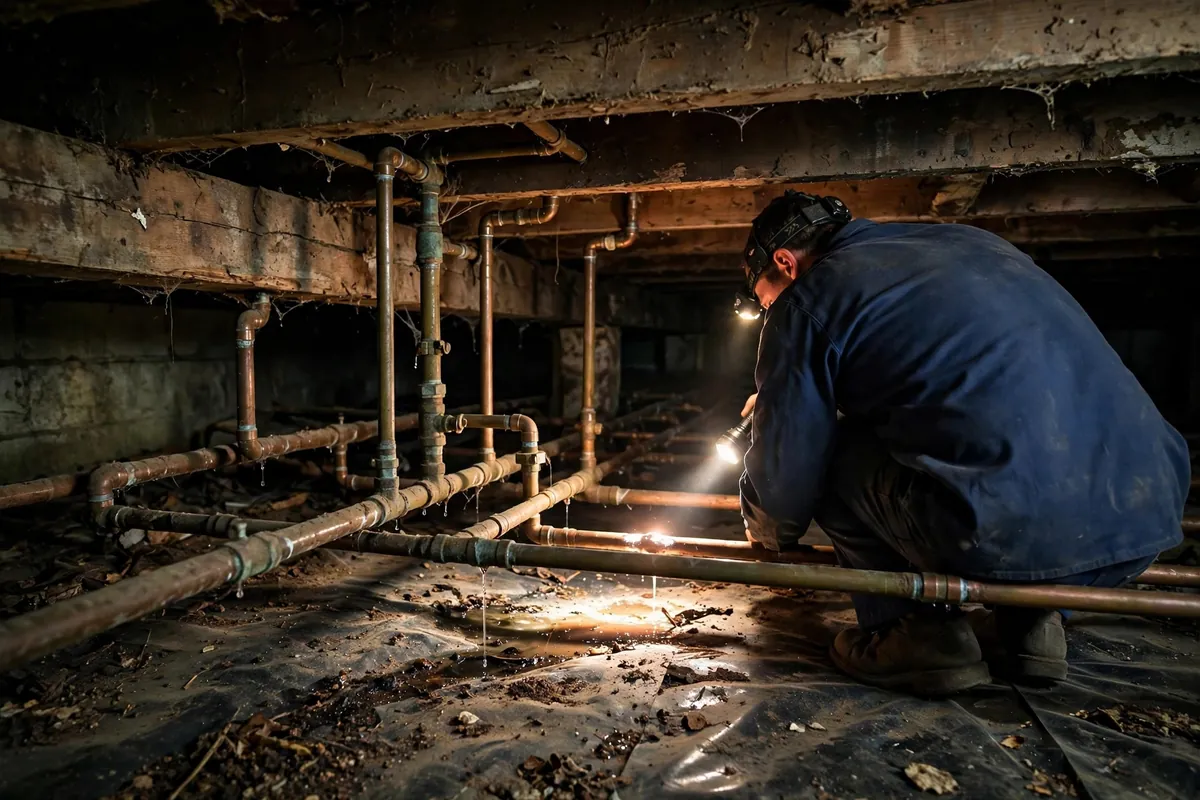
That foundation style shapes the whole leak story in this neighborhood. The water and drain lines run under the floor rather than inside a slab, which means two things. First, access: a technician can usually get eyes and gauges on the actual pipe from the crawl space, and a confirmed pinpoint rarely asks for any demolition at all. Second, concealment: an underfloor leak drips onto soil, not onto your kitchen tile, so it can run quietly until the evidence piles up — the soft floorboard, the smell that never quite airs out, the meter that creeps while the house sleeps.
The pipes themselves are the era's usual mix. Homes built around 1950 on the Peninsula were typically plumbed with galvanized steel supply lines and cast-iron drains, and Palm Park is squarely in that build wave — part of the generation that put most of the city's housing up between 1940 and 1980. Many homes have had a bathroom or kitchen modernized since, which adds the familiar weak point: new pipe tied into old, with the joint aging faster than either side of it. Our visits here test branch by branch, so the report separates the leak that brought us out from the condition of everything connected to it.
Palm to Locals, Palm Park to Everyone
However you name it, the coverage is the same — Palm Park is one of the ten areas in the service map on our Redwood City leak detection homepage, minutes from our Downtown office in the same corner of the 94061.
Leak Problems We See Most in Palm Park
Small homes, old pipes, quiet drips — the neighborhood pattern is underfloor leaks that take their time being noticed.
- Underfloor supply drips — pinholes in original galvanized branches wetting the crawl space for weeks
- Cast-iron drain corrosion — slow drainage and sewer smells as seventy-year-old pipe scales and cracks
- Old-meets-new joint leaks — remodeled kitchens and baths tied into original lines, failing at the fitting
- Leaking shut-off valves and fixture supplies — the small hardware of a 1950s house reaching the end together
- Yard line leaks near the sidewalk — the short meter-to-house run, invisible except on the meter
- Water heater drips — aging tanks and valves in garages and utility closets
The saving grace of a crawl-space home is that almost all of this can be proven before it is repaired. A pressure test on the branch and a look from below beats a guess from above, every time.
Do not overlook the small hardware, either. A 1950s house concentrates its risk in unglamorous places: the angle stops under every sink, the supply lines feeding every toilet, the fill valves and flappers inside tanks that may have been rebuilt a half-dozen times. Each part is inexpensive. Each one is also the same age as its neighbors, and a toilet supply connection that lets go does not drip politely — it runs at full line pressure until somebody finds it. When we test a Palm Park home branch by branch, that hardware is part of the inspection, and the report flags what is merely old versus what is actively tired.
It is a pattern worth respecting in a neighborhood of this age: the failures rarely arrive one at a time, but they do arrive in a readable order. The home that gets tested early replaces parts on its own schedule; the home that waits tends to meet the same parts all at once, usually on a holiday weekend.
Services We Run in Palm Park
The three calls that cover this neighborhood:
Crawl Space Leak Detection
Underfloor leaks in perimeter-foundation homes, confirmed from below before the subfloor suffers.
Learn more →Water Leak Detection
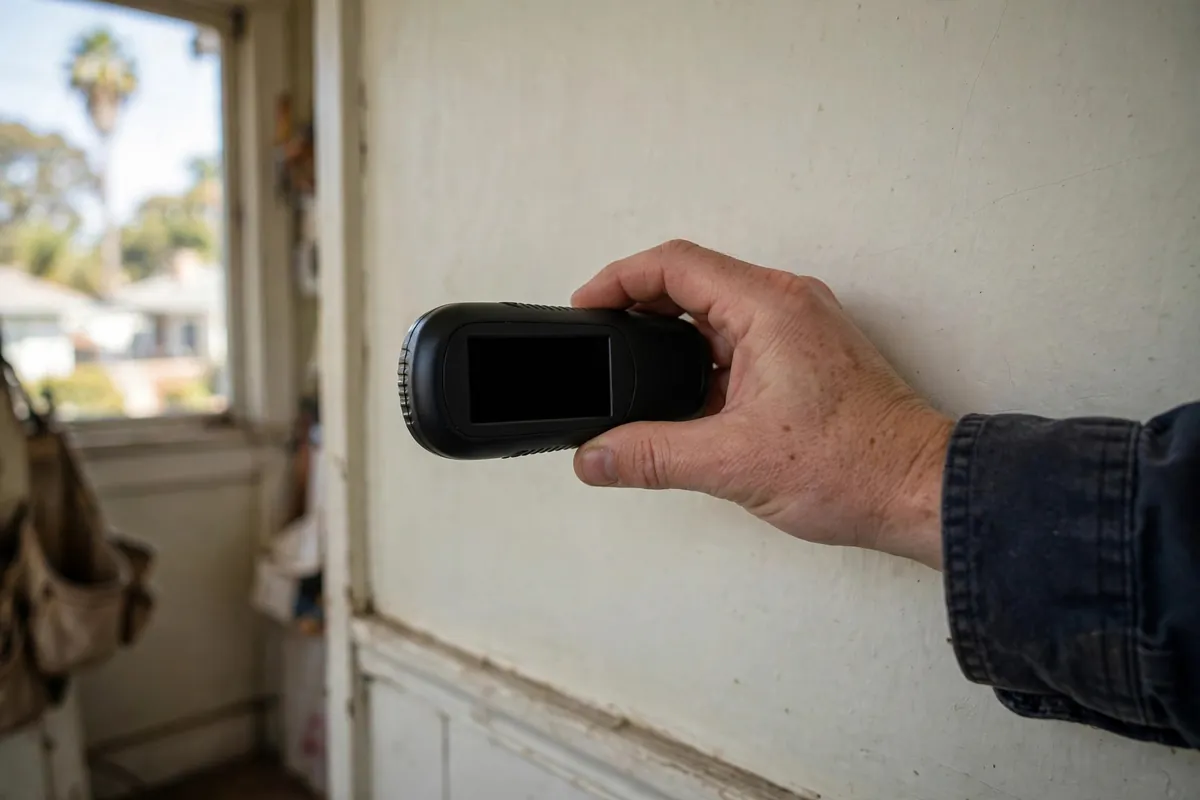
Wall, yard and fixture leaks traced with acoustic gear and moisture testing across the whole house.
Learn more →Faucet & Fixture Leaks
Drips, tired valves and leaking supply connections in original-era bathrooms and kitchens.
Learn more →Palm Park ZIP Code: 94061
Palm Park addresses — Palm Avenue, Oxford Street and the blocks between — sit in ZIP code 94061, one of five ZIP codes covered by our crew.
Surrounding areas on the same routes:
The Remodel Tie-In: This Neighborhood's Favorite Leak
Ask where Palm Park leaks start, and the honest answer is: at the seam between the house that was built and the house that was remodeled.
Very few of these homes still cook and bathe in their original rooms. Kitchens were opened up, bathrooms were retiled and re-plumbed, a laundry moved indoors — each project done well in its own decade. What each project also did was cut into plumbing from 1950 and join new pipe to old. Those joints live a harder life than either pipe beside them. Different metals expand at different rates, old threads meet new fittings at slightly tired angles, and the seal at the seam ages faster than the runs on both sides of it. Seventy years of small remodels means a Palm Park house can have a half-dozen of these seams, any one of which can be the first to weep.
That is why our testing here goes branch by branch instead of house-wide only. A whole-house pressure test can tell you water is escaping; it cannot tell you whether the loss is in the original galvanized run, the copper from the kitchen remodel, or the seam where the two meet. Isolating each branch and testing it separately can. The branch that fades gets traced, the seam gets found, and the repair is sized to the actual failure — a fitting, a section, a run — instead of to a guess about the whole house.
The good news is that seams fail small before they fail big. A tie-in leak usually starts as a weep: a joint that sweats under pressure, leaves a mineral crust, and keeps the surrounding wood or soil faintly damp. In a crawl-space home that evidence is visible from below months before it stains a ceiling or softens a floor, which is why a look from the crawl space belongs in the visit even when the symptom showed up indoors.
If you are planning a remodel of your own, the visit doubles as a map. Knowing exactly where the original lines run, which branches test sound, and where the old seams sit tells your future project where the plumbing can be trusted and where it should be renewed while the walls are already open — the one moment when renewing it is cheap.
Palm Park Leak Questions
Is it Palm Park or just Palm?
Both names point to the same streets. On the city's official neighborhood list the area is simply Palm, while locals and property listings usually call it Palm Park. We use Palm Park because that is what the people who live here call it — and either way, if your address is in the 94061 around Palm Avenue and Redwood Avenue, you are in the area this page covers.
What are the signs of an underfloor leak in a 1950s home?
A musty smell that lingers, one section of floor that feels soft or slightly uneven, hardwood starting to cup, and a water bill creeping up month over month. Underfloor leaks drip into the crawl space rather than pooling indoors, so the meter test settles it quickly: if the low-flow indicator moves with every fixture off, water is escaping below the house.
How long does a detection visit take here?
Most residential visits take one to three hours. Palm Park homes are compact and mostly raised-foundation, which usually makes the work straightforward: isolate the branch, pressure test it, confirm from the crawl space or with acoustic gear, and mark the spot. You get the marked location and a written summary the same visit.
What does it cost to find a leak in Palm Park?
A basic leak inspection typically runs $100–$300, electronic acoustic detection $300–$800, and slab or underground locating $500–$1,200. Most work in this neighborhood falls in the first two bands. The range is always quoted before work starts, and detection is priced separately from the repair.
Do you repair the leak after finding it?
Yes. Once the leak is pinpointed and documented, we walk you through the repair options for that line — a targeted section repair, a reroute, or repiping when the surrounding pipe is in the same condition — with price ranges for each. Nothing is bundled together, so the repair decision is yours, made with real numbers.
Should I replace old shut-off valves and supply lines while you are here?
Often, yes — it is some of the cheapest protection in the house. Angle stops corrode and seize with age, and flexible supply lines to toilets and faucets have a working life just like pipe does. Replacing tired hardware while a repair is already open costs a fraction of what a failed toilet connection costs in water damage. We point out what is corroded or stiff rather than recommending a blanket replacement of everything.
Is a slow drain in my 1950s bathroom a leak or a clog?
Usually neither word alone covers it. A single slow fixture is often a local clog. A whole branch draining slowly in a home of this era is more often cast iron narrowing from the inside with scale and corrosion. A leak is a third possibility, and the meter separates it from the other two — clogs and scale do not move the meter. A camera inspection, typically $271–$1,725 depending on the line and access, shows whether the pipe needs clearing, repair or neither.
Can you check the rest of the house while you are out for one leak?
Yes — in practice that is already how the visit works here. Because these homes are compact, isolating and pressure testing the branches covers most of the system in the same visit, and the written report separates the leak that brought us out from the condition of everything connected to it. If another branch is close to failing, you hear about it with test numbers attached, not as a sales pitch.
Small Neighborhood, Same Standard of Proof.
Whether the city calls it Palm or you call it Palm Park, a drip under a 1950s floor deserves a pinpoint, not a hunch. One visit marks the leak and prices the fix in ranges — with your floors still exactly where they were.
Call (650) 632-9185 Request a Quote