Leak Detection Redwood Oaks
Most leak detection Redwood Oaks calls come from the mid-century homes along the Woodside Road corridor — streets like Leahy and the blocks off Woodside Road itself, where the plumbing has been underground and out of sight for sixty-plus years. Out of sight is the operative phrase: the typical call here is not a flood, it is a meter that creeps, a patch of lawn that stays green in August, or a drain that has slowed down for the third time. Leak Detection Pros traces those lines electronically and pinpoints the failure before a single shovel of soil moves.
Corridor Homes and Their Buried Lines
Redwood Oaks grew up along the Woodside Road corridor in the city's mid-century decades, and most of its plumbing story runs underground — in yard lines, laterals and irrigation.
Every home here depends on buried infrastructure that never gets looked at: the water service line running from the street meter to the house, the sewer lateral running back out to the main, and, on these established lots, irrigation lines threading through mature landscaping. All three were installed in the same era as the homes — the decades when Redwood City put up most of its housing — and all three age in the dark. Metal service lines corrode at fittings. Clay and cast-iron laterals crack and invite roots at every joint. Irrigation valves and lines, cycled season after season, start passing water nobody ordered.
The saving grace is that buried does not mean unknowable. A modern detection visit maps the runs electronically, pressure-tests the supply side branch by branch, and runs a camera through the drain side so its condition is visible on a screen. In a neighborhood where the expensive mistake is digging in the wrong place — through root systems, driveways and finished landscaping — proof before excavation is not a luxury. It is the whole job.
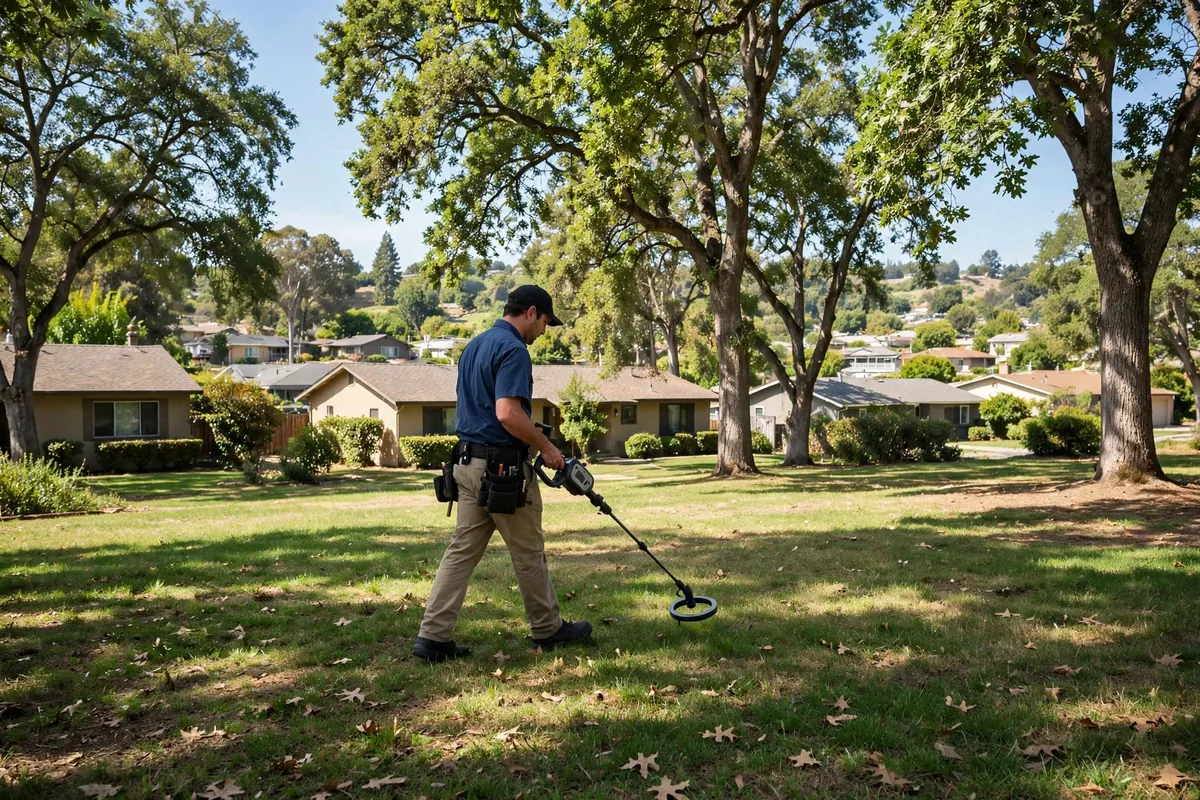
The Lawn Is a Witness, Not a Map
A green patch or a soggy corner tells you water is escaping — it does not tell you where. Water travels along the pipe trench before it rises. We mark pipes, not puddles, and the written report shows the traced run so the repair crew digs once.
Leak Problems We See Most in Redwood Oaks
Buried-line problems dominate here: yard runs, laterals and irrigation, all aging on the same schedule as the homes.
- Service line leaks — the meter-to-house run losing water underground, announced only by the meter and the bill
- Sewer lateral cracks and root intrusion — slow drains and repeat backups along the Woodside Road corridor's older lines
- Irrigation line and valve leaks — established landscaping quietly drinking water between scheduled cycles
- Interior wall and ceiling leaks — supply failures in original-era plumbing showing as stains far from the source
- Drain sags and scale — aging cast iron narrowing and holding water, visible only on a camera
- Pressure-driven fitting failures — high street pressure working on sixty-year-old joints
Nearly every item on that list shares one trait: the fix is straightforward once the location is proven, and expensive when it is guessed. That is the order we work in — proof first, quote second.
The corridor adds one more consideration: hardscape. On these established lots, buried lines routinely pass under driveways, patios, walkways and the root zones of trees that have been growing since the houses were new. Every one of those crossings raises the price of guessing. A trench dug on a hunch does not just miss the leak — it takes a piece of finished driveway or a mature root system with it on the way to missing. That is the practical argument for the trace: on a Redwood Oaks lot, proof is not thoroughness for its own sake. It is what keeps a plumbing problem from becoming a landscaping and concrete problem as well.
There is a quieter benefit to working this way on a mature lot. Mature trees and old laterals have grown into each other over decades, and a repair that respects the traced map also respects the root zones — the tree shading your house is frequently the same tree whose roots found the lateral, and keeping it healthy is part of doing the job properly.

Services We Run in Redwood Oaks
The services behind most corridor calls — each one runs on the process described on our Redwood City leak detection homepage:
Water Leak Detection
Buried service lines and hidden interior leaks traced electronically and pinpointed before any digging.
Learn more →Sewer Leak Detection
Camera inspection of laterals and drains — cracks, roots and sags on screen, with the footage as your evidence.
Learn more →Irrigation Leak Repair
Broken lines and passing valves in established landscaping, found by zone testing instead of flooding the yard.
Learn more →Redwood Oaks ZIP Code: 94061
Redwood Oaks addresses sit in ZIP code 94061, along and behind Woodside Road — one of five ZIP codes our crew covers across Redwood City.
Neighboring areas with the same mid-century profile:
A Yard-Line Visit on the Corridor, Step by Step
When the house is dry and the meter is moving, the job is underground. Here is how that visit runs, from the curb to the mark.
It opens with a ten-minute experiment at the meter. Everything in the house goes off — faucets, toilets, irrigation, the ice maker — and we watch the low-flow indicator. If it moves, water is leaving the system somewhere between the meter and your taps. Closing the house valve splits the property in two: a meter that stops points indoors; a meter that keeps turning confirms the buried yard run, and the visit moves outside for good.
Next the line gets drawn on the ground. Using an electronic trace, we follow the service line from the meter across the yard — and on corridor lots, that path is rarely the straight line a guess would draw. Older runs bend around trees that were small when the pipe went in, cross under the driveway at an angle, and tee off toward irrigation in places no plan survives to document. The trace records the actual route, with depth, so the map exists before the leak is even located.
With the route known, the listening begins. Acoustic sensors work along the traced line, and the sound of pressurized water escaping soil has a signature that strengthens as you near the break and dies as you pass it. The mark that results is not the wettest patch or the greenest grass — those are where water ended up. It is the spot on the pipe where the sound peaks, cross-checked against the pressure test that isolated the run in the first place.
Only then do we talk about digging and repair, with the map in hand. One opening, over the failed section, is the normal shape of the job. The written report keeps the traced route, the depth and the test results — paperwork that stays useful long after the hole is filled, the next time any crew needs to know where your water actually runs.
Redwood Oaks Leak Questions
My bill jumped but the house looks dry. Where should I look first?
At the meter, not at the house. Turn everything off and watch the low-flow indicator: if it moves, water is escaping between the meter and your taps — very often in the buried yard line, which never shows a puddle until the loss is large. Redwood City's My Water portal adds the pattern: usage running through the night points to a supply or yard leak, while daytime-only spikes suggest irrigation.
Why is the wet spot in my yard nowhere near the actual leak?
Escaping water follows the loose fill of the pipe trench and the easiest path through the soil, so it can surface a surprising distance from the break — or travel along the pipe itself. Digging at the wet spot is the classic expensive mistake. We trace the line electronically and listen along its run, so the mark lands on the pipe.
What does a camera inspection actually show?
A small camera travels through the drain or sewer lateral and shows its condition on screen in real time — cracks, root intrusion, offset joints, scale buildup and standing water where a sag has formed. You watch the same footage we do, which turns the repair conversation from opinion into evidence: clear it, line it, or replace the section we just looked at.
What does leak locating cost in Redwood Oaks?
A basic leak inspection typically runs $100–$300, electronic acoustic detection $300–$800, and slab or underground locating $500–$1,200. A sewer camera inspection generally runs $271–$1,725 depending on the line and access. Every range is quoted before work starts, and detection is always priced separately from the repair.
Will my insurance cover water damage from a buried line leak?
Often the resulting damage and the cost of getting access to the failed line are covered, while the pipe repair itself usually is not, and slow leaks that ran for months are commonly denied as gradual deterioration. Every policy differs. Our written detection report documents the source, the path and the damage, which is the evidence an adjuster needs to see.
How big a hole gets dug once you pinpoint the leak?
A small one. The pinpoint narrows the failure to a marked spot on a traced line, so the excavation is sized to the repair itself — typically one opening over the failed section, with the rest of the run left buried and untouched. Compare that with the alternative: trenching along a guessed path until the break turns up. The traced map is exactly what keeps the shovel honest.
Do you have to cut my driveway to reach the water line?
Usually not. The pinpoint comes first, and it decides the question. If the failed section sits beside the driveway, the dig stays in the soil. If the break is genuinely under the concrete, the options are a single targeted opening at the break or rerunning that stretch of line around the hardscape — each priced in ranges from the traced map before anyone commits. What we will not do is cut concrete on a suspicion.
Can the roots just be cleared, or does the lateral have to be replaced?
Clearing is a fair answer when the pipe itself is sound and the roots entered through one open joint — it restores flow and buys real time. It is a poor answer when the camera shows the pipe cracked, offset or bellied, because the roots will return through the same damage. The footage makes the call: you see the joint or the crack yourself, and the repair is aimed at the section that failed instead of the whole lateral by default.
Buried Does Not Mean Unknowable.
If the meter is moving and the house looks dry, the answer is underground — and it can be proven to the foot before anyone digs. One visit traces the lines, marks the leak and prices the repair in ranges.
Call (650) 632-9185 Request a Quote