Leak Detection Roosevelt Redwood City
Most leak detection Roosevelt Redwood City calls come from the older homes along and behind the Roosevelt Avenue corridor — streets of central-city houses whose plumbing spans several eras at once. A sound of running water at midnight, a wall that feels damp, a bill drifting upward: in homes like these, the leak is rarely where the symptom is. Leak Detection Pros isolates each line, pressure tests it, and pinpoints the failure with acoustic and thermal equipment, so the repair starts from a mark on the wall or floor — not from a hunch.
Central Streets, Mixed-Era Plumbing
Roosevelt is one of the city's older central neighborhoods, and its homes carry plumbing from every decade they have lived through.
This part of Redwood City filled in early and kept changing. Houses here have been extended, converted and remodeled in waves, and the plumbing tells the story: an original galvanized run feeding a copper bathroom addition, a newer water heater tied into lines from another era, drains that start in cast iron and end in something younger. Each material ages differently, and each joint between eras is a place water can eventually find its way out. With 61% of Redwood City's homes built between 1940 and 1980, this mixed-era pattern is the rule in the central neighborhoods, not the exception.
Foundations vary street by street as well — raised perimeters with crawl spaces on many of the older homes, slabs under some later builds and additions. So a Roosevelt detection visit never assumes. We establish what your house actually sits on and how it is actually plumbed, branch by branch, because the fastest way to waste a homeowner's money is to go hunting for a slab leak under a house that has a crawl space, or the reverse. Once the map is right, the pinpoint follows quickly.
The Midnight Sound Test
When the house is quiet, stand still and listen. If you hear water moving and every tap is off, something is leaking. It is the most common first clue Roosevelt homeowners report — and it is worth a call the same week, not the same season.
Leak Problems We See Most in Roosevelt
The central-city pattern: era joints, wall leaks and water heaters quietly giving up in garages and closets.
- Leaks where plumbing eras meet — newer copper or PEX tied into old galvanized, failing at the transition fitting
- Hidden wall leaks — damp paint, bubbling plaster and musty smells in rooms that share a wet wall
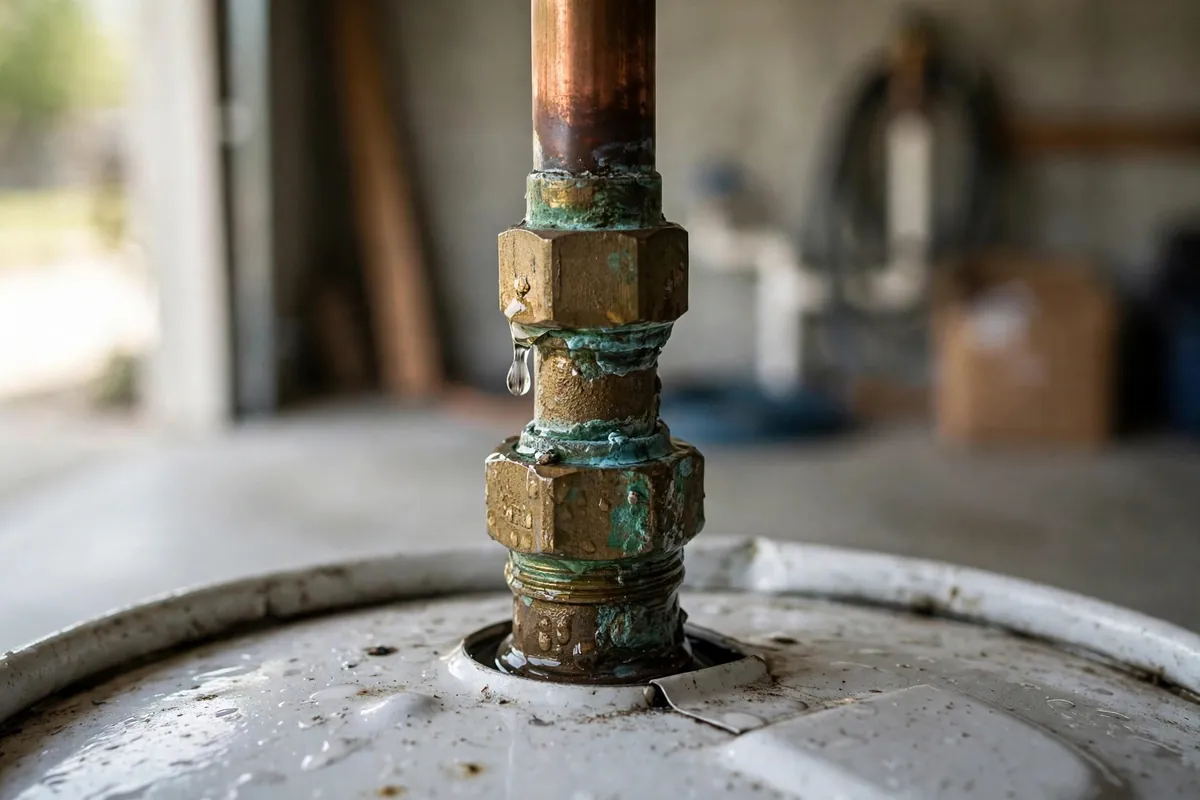
- Water heater leaks — tanks and relief valves at the end of their life, weeping into pans, closets and garages
- Running-water sounds with no source — supply leaks under floors or behind walls, audible before they are visible
- Slow drains in older lines — cast-iron scaling and root pressure at the lateral joints
- Yard line leaks — the buried run from the meter showing up only as meter movement and a higher bill
What ties these together is that the symptom and the source are usually in different rooms. Water travels along pipes, framing and slab edges before it stains anything. Tracing, not chasing, is what keeps the repair small.
The era joints on that list deserve one more sentence, because they fail for a mechanical reason. When a remodel ties a newer metal into an older one — copper into galvanized steel is the classic pairing in these homes — the two materials do not age at the same rate, and the meeting point corrodes faster than the pipe on either side of it. Tradespeople have a rule of thumb about such transitions: the fitting is the fuse. That is why a Roosevelt visit maps the transitions deliberately, house by house, instead of treating the plumbing as one uniform system. In a converted or repeatedly remodeled home, the map is half the diagnosis.
Services We Run in Roosevelt
The Roosevelt regulars:
Water Leak Detection
Wall, floor and yard-line leaks traced acoustically and thermally, wherever the eras of your plumbing meet.
Learn more →Water Heater Leak Repair
Puddles at the tank, rust at the fittings, relief valves that will not stop dripping — found, explained and fixed.
Learn more →Drain Cleaning
Slow drains in older lines cleared properly, with a camera inspection when the same blockage keeps coming back.
Learn more →Roosevelt ZIP Code: 94061
Roosevelt addresses sit in ZIP code 94061, in the heart of the city — a short run from our Downtown office, and one of five ZIP codes we cover.
Start from our leak detection homepage for Redwood City for the full step-by-step of a detection visit, or browse the neighboring areas:
The Midnight Sound: Tracing a Leak You Can Hear but Not See
It is the most common Roosevelt story we hear: the house is quiet, nothing is running, and yet somewhere water is moving. Here is where that sound usually leads.
The sound itself is the first instrument. Pressurized water escaping through a pinhole or a failing joint makes noise that travels along the pipe itself, which is why you may hear it most clearly in a room the leak is not in. Homeowners localize it wrong with complete confidence — the pipe is a speaking tube, and it carries the leak's voice to wherever the tube ends. Our first move is not to follow the sound but to verify it: shut the house valve and listen again. Silence confirms the leak is on the house side. A sound that continues points outside, to the yard run.
One suspect gets cleared before any equipment comes out: the toilets. A fill valve that cycles on its own, topping up a tank that is slowly leaking into its bowl, imitates a supply leak perfectly — right down to the midnight timing, when nobody is awake to flush. The dye test and a look at the meter separate the impersonator from the real thing in minutes. It is a deflating answer when it is just a flapper, but it is the cheapest diagnosis in plumbing, and ruling it out is what makes the rest of the hunt honest.
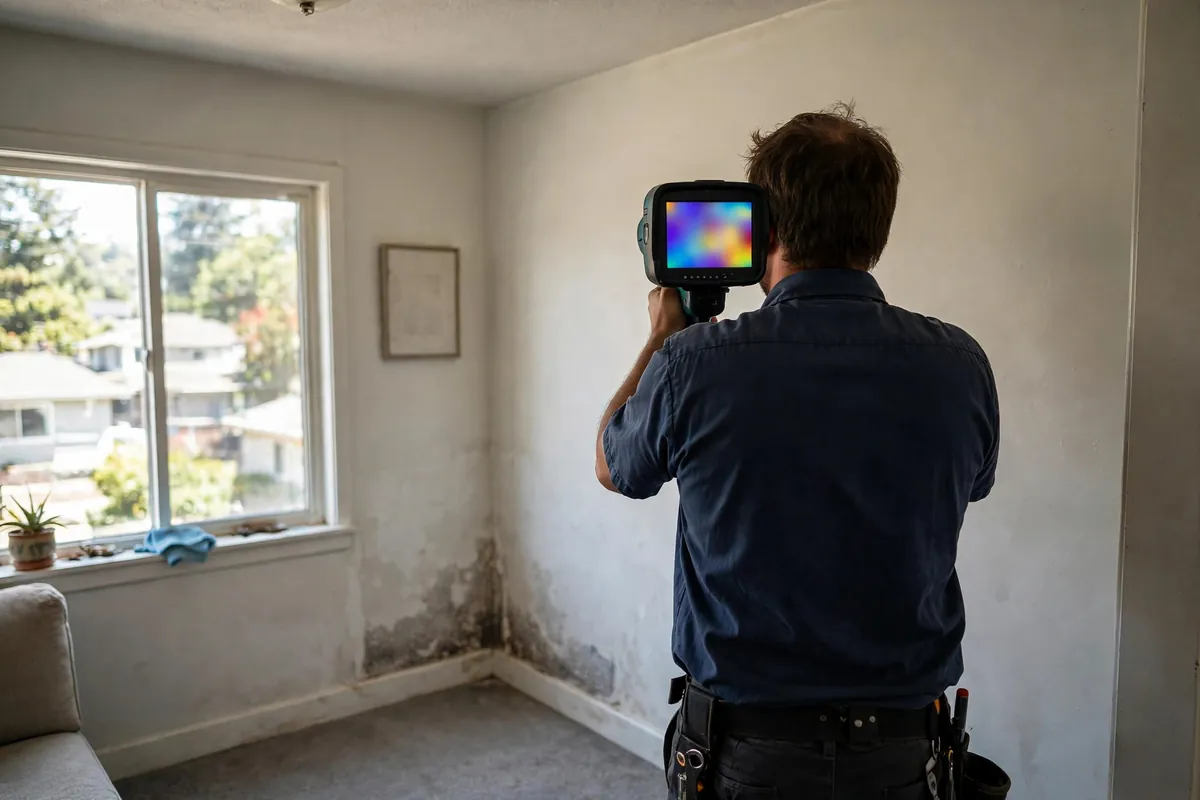
If the loss is real, the branches get isolated and pressure tested, and then the two instruments that settle Roosevelt arguments come out. The acoustic sensor walks the walls and floors, following the escaping water's noise back along the pipe to its peak — the point where sound stops traveling and starts escaping. The thermal camera reads the wall for the faint temperature signature a hot-water leak leaves behind plaster. Where the two agree, the mark goes down: a small area, chosen by evidence, in a home where opening the wrong wall helps nobody.
The visit ends with the map and the mark together — which lines your house actually has, which era each belongs to, and the exact spot the failing one needs attention. In a neighborhood of layered, converted, much-remodeled homes, that map is often the first accurate picture of the plumbing anyone has ever had, and it stays useful long after this particular leak is fixed.
Roosevelt Leak Questions
I hear water running when everything is off. Is that a leak?
Almost always, yes — or a toilet filling valve cycling, which is a leak of its own kind. Water moving through a pipe makes that sound, and if no fixture is open, the water is going somewhere it should not. Shut the house valve and listen again: if the sound stops, the leak is on the house side, and a meter check will confirm how fast you are losing water.
How long does a detection visit take in a Roosevelt home?
Most residential visits take one to three hours. We isolate the lines one branch at a time, pressure test, and then pinpoint with acoustic and thermal equipment. Older central-city homes with layered remodels can take a little longer to map, and you get a marked location and a written summary the same visit.
Can you really find a leak inside a wall without opening it?
Yes. Acoustic listening equipment picks up the sound of pressurized water escaping, and a thermal camera shows the temperature change a hidden hot-water leak leaves on the wall surface. Between the two, the leak is usually narrowed to a small marked area — so if a section of wall does need opening for the repair, it is one targeted cut, not exploratory demolition.
What will the visit cost me?
A basic leak inspection typically runs $100–$300, electronic acoustic detection $300–$800, and slab or underground locating $500–$1,200, depending on the home and how hidden the leak is. The range is quoted before work starts, and detection is priced separately from any repair, so you are never paying to find a leak and fix it in one bundled surprise.
If the leak damaged my walls or floors, will insurance cover it?
Often the resulting damage and the cost of opening and restoring access are covered, while the failed pipe itself usually is not, and damage from a slow leak that went on for months is commonly denied as gradual. Every policy differs. Our written report documents when the leak likely started and what it damaged, which is exactly what an adjuster asks for.
I rent my home. Who is responsible for fixing a leak?
In California, the landlord. Civil Code section 1941.1 makes keeping the plumbing in working order the landlord's responsibility, unless the tenant caused the damage. Your own belongings are a separate matter — those fall to renter's insurance. Tell your landlord promptly and in writing; entry for repairs generally requires 24 hours' written notice under Civil Code section 1954, emergencies aside. A written detection report helps everyone here: it proves the source, the timing and the damage without argument.
My water heater sits in an inside closet. What should I watch for?
A closet heater leaks into framing and flooring where nobody looks, so a monthly glance is worth the ten seconds it takes. Watch for dampness at the base or in the pan, rust streaks running down from the top fittings, and a relief valve that drips steadily instead of occasionally. A puddle that keeps returning after you dry it is not condensation — it is a fitting or the tank announcing itself, and it deserves a call before the closet floor does the announcing instead.
Can a leak raise my bill even if I never see any water?
Yes — the meter counts water you never see exactly the same as water you use. A supply leak under a floor or in a yard line sends its water into soil and framing, and even a modest continuous loss adds up across a billing cycle. That is why the bill is evidence, not a mystery: the meter and the My Water portal can prove water is escaping and how fast, even when the house looks completely dry. The visit exists to answer the one question the meter cannot — where.
Hearing Water That Should Not Be Running?
Trust your ears, then let the equipment settle it. One visit maps your Roosevelt home's lines, pinpoints the leak, and prices the fix in ranges — before a single wall is opened.
Call (650) 632-9185 Request a Quote